Wednesday, March 24, 2010
3rd Quarter Blog!
My favorite blog post this quarter was probably "All Around Knowledge". I like that I took what we talked about in class and continued the discussion on my own blog. As I continued the discussion in this blog, I brought up the fact that just because the world may be filled with problems does not mean we necessarily need a "problem-solving-brain". In my mind problems have two different approaches and in order to find the best solution we need both approaches. The logical, and the creative. Starting our Junior Theme now in class I came upon a book in the library that talked about how the right brain (the more creative brain) is starting to take more dominane than the left brain has in the past. I immediately thought of this discussion and my blog post about how creative brains are very much needed in the world. It seems counter-intuitive with such a technology based upcoming world, but if you think about it technology really is creativity. And thats where the two collide and create the best possible solution. (As I explained briefly in my blog post)

Thursday, March 18, 2010
Privacy vs. Security
We all heard about the possibility of having a "full-body scan"at airports but we never thought the day would come. Or maybe did think it would. But either way, the day HAS come. And it has reached O'Hare airport.
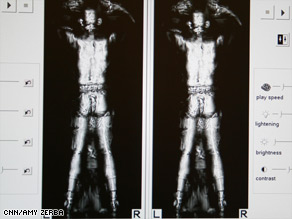 The scanner has caused some controversy between people as all new additions usually do. These scanners are designed to find hard to detect explosives but producing an x-ray of the entire body of someone within seconds. The picture that comes from it is almost like a naked picture and a passenger, quoted in an AOL article, says "I feel violated knowing they can see under my clothes, I'm a very modest person". There is an option to be patted down by a TSA agent, but most people would rather be scanned then touched and felt over by some officer. A CNN article gives a counter argument for the privacy saying that, "This system uses a pair of security officers. The one working the machine never sees the image, which appears on a computer screen behind closed doors elsewhere; and the remotely located officer who sees the image never sees the passenger". Yet this article still address the issue of privacy. The idea that the technology can really do more than they say it can, and more.
As I finished reading the second article I came across a comment that is something I always think about when relating to security, "It's stupid to spend money so terrorists can change plans". When we bring more security to airports then terrorists will either just work to find new ways around the system, or just find other places to attack and more creative, confusing ways at that. As we get smarter, they do too. Its a confusing concept, and very scary.
What do you think about the scanners? Do you feel violated? Is the security worth it?
The scanner has caused some controversy between people as all new additions usually do. These scanners are designed to find hard to detect explosives but producing an x-ray of the entire body of someone within seconds. The picture that comes from it is almost like a naked picture and a passenger, quoted in an AOL article, says "I feel violated knowing they can see under my clothes, I'm a very modest person". There is an option to be patted down by a TSA agent, but most people would rather be scanned then touched and felt over by some officer. A CNN article gives a counter argument for the privacy saying that, "This system uses a pair of security officers. The one working the machine never sees the image, which appears on a computer screen behind closed doors elsewhere; and the remotely located officer who sees the image never sees the passenger". Yet this article still address the issue of privacy. The idea that the technology can really do more than they say it can, and more.As I finished reading the second article I came across a comment that is something I always think about when relating to security, "It's stupid to spend money so terrorists can change plans". When we bring more security to airports then terrorists will either just work to find new ways around the system, or just find other places to attack and more creative, confusing ways at that. As we get smarter, they do too. Its a confusing concept, and very scary.
What do you think about the scanners? Do you feel violated? Is the security worth it?
Wednesday, March 17, 2010
Can there be TOO many advertisements?
In class we have been talking about advertisements and how they affect our world and our choices. The country Russia came up in the conversation of almost no advertisements. Both my teacher and another student commented on how different and weird it felt to not have any advertisements. Daniel Boostin commented on how being back in the United States was a relief. He explained, "the flourishing of advertising then is a clue to the increasing opportunities for choice" compared to no opportunities for choice.
Yet, when I thought of a world filled with advertisements (well even more than the present) I not only cringed, I began to be skeptical. What if everything everywhere was advertised? Would their even be a need for advertisements?Advertisements in my head make certain products stand out, or at least make them known to you. But with too many my brain would be too bombarded with too many products and in my present mind, I'd feel they'd just all cancel each other out. How could I make my choices if every single choice was screaming in my face? As I think of the world to come I try to imagine what will become of all the advertisements and what new (and potentially scary) ways advertisers approach us next. What do you think?
Yet, when I thought of a world filled with advertisements (well even more than the present) I not only cringed, I began to be skeptical. What if everything everywhere was advertised? Would their even be a need for advertisements?Advertisements in my head make certain products stand out, or at least make them known to you. But with too many my brain would be too bombarded with too many products and in my present mind, I'd feel they'd just all cancel each other out. How could I make my choices if every single choice was screaming in my face? As I think of the world to come I try to imagine what will become of all the advertisements and what new (and potentially scary) ways advertisers approach us next. What do you think?
Sunday, March 14, 2010
Modern Marriage
This weekend I saw the school's play "Thoroughly Modern Millie", twice. Millie has come to New York, ready for a new "modern" life. After learning about the 20's in class, it was interesting to see the play and recognize things. The younger girls in the play all wear flapper-type dresses and go out to party at speak-easies. Millie also has this "plan" in mind. What she swears is the "modern way". She plans to marry her boss, so to marry rich, claiming love comes later. She claims a "modern girl takes charge of her life". In the end she is persuaded by love, but she spoke so strongly of the plan, even referring back to "Vogue" where she read about it.

I found it interesting once again how view points and life changed so rapidly around the 20s for women. The 1920s was a decade starting to be run by business and then Millie refers to marriage as a "business arrangement". So as the nation changed, viewpoints changed. This made me think of how women see marriage today. I found myself debating against myself. I'd like to think that people are more romantic and marry for love but then I thought about "gold diggers" and "cougars" and those sorts.
How do you see marriage today? What you'd like it to be, or what it is in reality? How has it changed?
Tuesday, March 9, 2010
Who needs drugs when we have video games?
So, cracked.com. I could do a blogpost all about that site, it's great, read it. But, I'm just going to talk about an article I found on it, or rather, my sister found and showed me. It's scary and whether it is completely true or not, it all makes sense. Anywho:
Poll: How many of you have played video games before?
How many of you are addicted to at least one?
Ok, so maybe this isn't the best time to be asking this question to my fellow 4 level high school students, but you get the point. I'm sure you know someone who is/was obsessed with some type of game.
This article is entitled 5 Creepy Ways Video Games Are Trying to Get You Addicted, and reading these ways I just cringe inside, because they are so true. I could go on about all the ways but I would never do them justice. I would just read the article if I were you, you will get amusement (and fear) out of it.
 What I'm really getting at is how scary this is. I have found myself addicted to certain games, repetitive and boring, yet still pulled into them, and I know plenty of people who have addictions. The way these games are crafted to keep you coming back for more, to keep you going, that there are scientists just for this job. The science of gaming addiction. I'm not kidding. It's ridiculous. Games no longer care if someone buys their game and never plays it. It now feeds into the internet, and real money. There are games that require real money to be sent in to do certain tasks, receive a certain "golden key" that will open a "special door". These types of ploys are everywhere, and people soak them right up.
Yet getting at my title, video games are just as dangerous as drugs. It's true. The article links to another article about a couple starving their own child, and there have been more deaths associated with video games as well. People coop themselves up in rooms all alone, addicted to their fictional friends, or their online friends. And they think they're fine. People need real connections to the world, and without these they can find themselves cut off, depressed, only feeling better when back int heir games. Thus, the viscous cycle continues.
Poll: How many of you have played video games before?
How many of you are addicted to at least one?
Ok, so maybe this isn't the best time to be asking this question to my fellow 4 level high school students, but you get the point. I'm sure you know someone who is/was obsessed with some type of game.
This article is entitled 5 Creepy Ways Video Games Are Trying to Get You Addicted, and reading these ways I just cringe inside, because they are so true. I could go on about all the ways but I would never do them justice. I would just read the article if I were you, you will get amusement (and fear) out of it.
What I'm really getting at is how scary this is. I have found myself addicted to certain games, repetitive and boring, yet still pulled into them, and I know plenty of people who have addictions. The way these games are crafted to keep you coming back for more, to keep you going, that there are scientists just for this job. The science of gaming addiction. I'm not kidding. It's ridiculous. Games no longer care if someone buys their game and never plays it. It now feeds into the internet, and real money. There are games that require real money to be sent in to do certain tasks, receive a certain "golden key" that will open a "special door". These types of ploys are everywhere, and people soak them right up. Yet getting at my title, video games are just as dangerous as drugs. It's true. The article links to another article about a couple starving their own child, and there have been more deaths associated with video games as well. People coop themselves up in rooms all alone, addicted to their fictional friends, or their online friends. And they think they're fine. People need real connections to the world, and without these they can find themselves cut off, depressed, only feeling better when back int heir games. Thus, the viscous cycle continues.
Monday, March 1, 2010
You there! Go make a living!
Today Mr. O'Connor talked about what it means to "make a living", a very common phrase used around our society. It is usually meant to describe what someone's does when they get a job and start making money. The focus here on money. Then Mr. O'Connor asked what was our definition of "making a living".
 I am all for the idea of life being a "construction", but I feel like the construction is very individualized. My "making a living" would include getting a degree, finding a good job, but the manner at which it is done seems different than this robotic idea. If I take a year to relax, to do something that interests me; or if I am interested in something with little job opportunities and am just happy the way I am, so be it; or if I go out of order of this original "recipe", that's that. And I believe that's how many people I know think. What do we strive for? Well happiness of course! But the pressure is on from society for us to just go and"make a living!" It can't be that hard, right? But with the pre-determined connotations it brings it makes our mindset stuck on that one item, money. If we don't have money, we are not successful people.
Interested in what the images on the interwebs would portray, I typed in "make a living" into Google images. Most images did not have much to do with what I was talking about, but what I found with the few that did was the common theme of money. It makes sense, even to me, to think about "making a living" as "getting money", but when I grow up and "make a living" I'd really stick a different definition to that. And most likely not even use that phrase. The idea that I am just "making" this life sounds like I am taking a recipe out of a generic cookbook.
1. Go to school
2. Get a degree
3. Get a job
4. Make money
5. Start a family
6. Make more money
7. Retire
I am all for the idea of life being a "construction", but I feel like the construction is very individualized. My "making a living" would include getting a degree, finding a good job, but the manner at which it is done seems different than this robotic idea. If I take a year to relax, to do something that interests me; or if I am interested in something with little job opportunities and am just happy the way I am, so be it; or if I go out of order of this original "recipe", that's that. And I believe that's how many people I know think. What do we strive for? Well happiness of course! But the pressure is on from society for us to just go and"make a living!" It can't be that hard, right? But with the pre-determined connotations it brings it makes our mindset stuck on that one item, money. If we don't have money, we are not successful people. Which I do not find true at all.
All Around Knowledge
In class today we talked about giving money to the Arts and how we feel about that in an economically depressed nation, as ours is right now. For me, I would support that. I feel that having knowledge and exposure to the Arts actually supplements one's knowledge and can only help that person. Without the exposure of Arts we'd probably be a less developed world.
 I think that learning about using creative energy and actually utilizing that creative energy is healthy for our bodies. As science has showed (also reference to what Ruchi said today), the right brain contributes more creative thoughts, while the left brain is a logical thinker. To only be using one side of your brain doesn't sound like a very good idea does it? I agree with the fact that murals and music can help boost someone's feelings but I really think that without learning to use the creative part of our brains we would not understand much of the logic we understand today. Solving problems is not always logical. Sometimes we need to come at them in a different, more creative way. Cutting out that creative side would slow down progress, even scientific "logic-based" progress enormously.
Subscribe to:
Posts (Atom)
